
AUGUST 1814
For three days in the late summer of 1814, the country had no capital. On the third night, it had one again – in a small Maryland village, in a house on Market Street, in the parlor of a Quaker silversmith named Caleb Bentley. This is the story of how Brookeville became the Capital for a Day.
The afternoon was hot. American militia had broken at Bladensburg, and the road to Washington was open. By evening, British troops were inside the city. They burned the Capitol first. Then the White House. Then the Treasury, the War Office, the President’s stables. The fires were so bright that residents thirty miles away said the sky to the south glowed orange through the night.
President James Madison watched from a hill across the Potomac. He had ridden out of the city only hours before – a fresh horse, a few packed papers, a small party of advisors. By the time the buildings burned, he was already on the Georgetown Road, headed west into Virginia.
The United States, at that hour, had no functioning capital. The President was on horseback. The First Lady was sheltering thirty miles to the north. The cabinet was scattered across two states. The country, in any meaningful sense, was empty at its center.
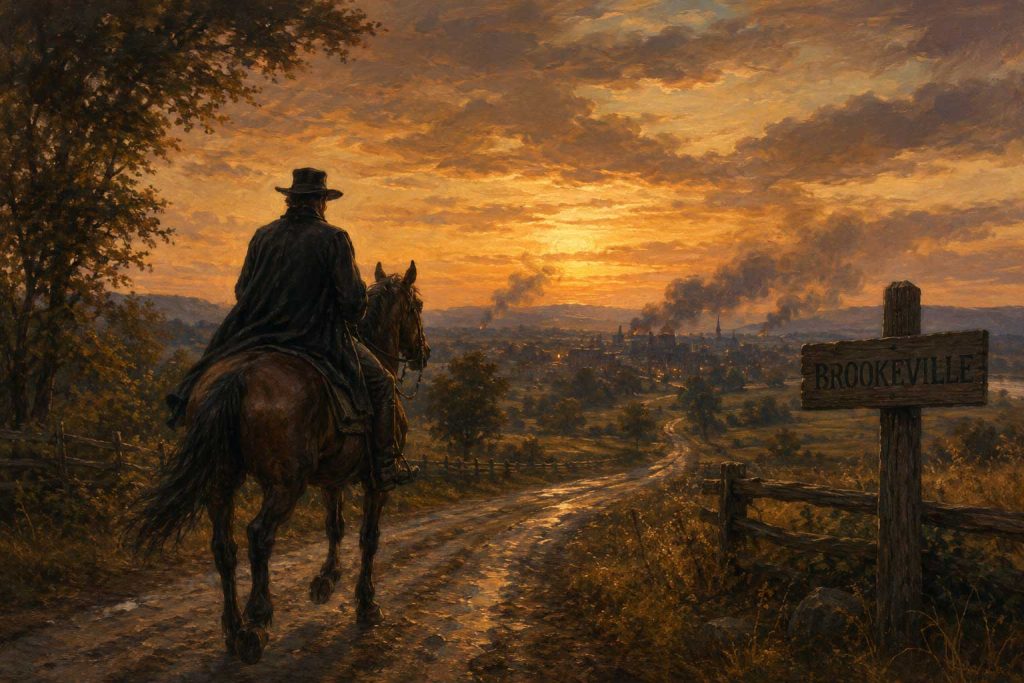
Madison spent the next day moving from refuge to refuge in Virginia. Falls Church. Salona. Wiley’s Tavern. Late that night, with a severe storm rolling across the Potomac, he set out again – this time heading north, back into Maryland, to find what remained of his army at Montgomery Court House.
The storm slowed him. The ferry at Conn’s was nearly impassable by morning. By the time he reached Montgomery Court House on the afternoon of August 26, his troops had already moved on.
He continued north. Eleven more miles, on horseback, in fading light. The road climbed gently through farmland. Smoke from the burning capital was still visible to the south. He was looking for somewhere safe to spend the night.
He found Brookeville.
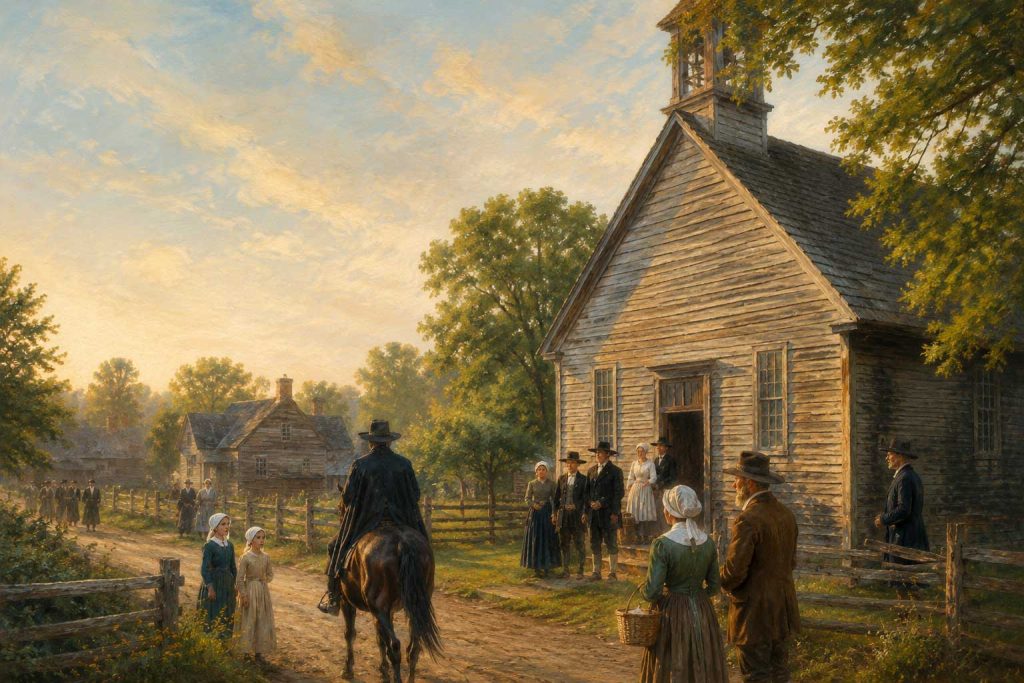
Brookeville in 1814 was a small but prosperous village of about a hundred and fifty residents – mostly Quakers, mostly farmers and millers, with a tight community life centered on the meetinghouse and the school. The town had been founded twenty years earlier, in 1794, by Friends families who had chosen the land along Reddy Branch for its mills and its quiet.
By the time Madison arrived, the village was already full. Refugees from Washington had been streaming into Brookeville for two days. The Bentleys’ house, the Riggs’ house, the homes of the Thomas family – all of them had opened their doors. Margaret Bayard Smith, a Washington writer whose family had fled the city, was staying with the Bentleys when the President rode in.
Her daughters were the first to see him.
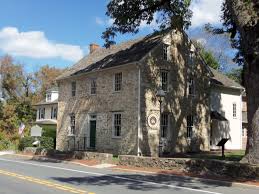
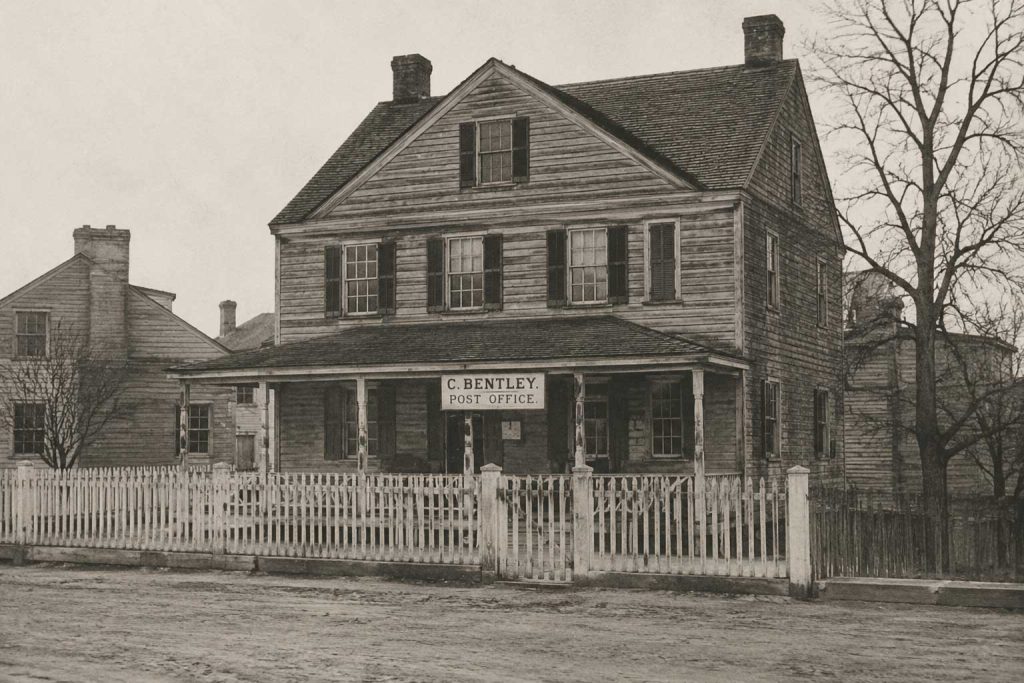
The house that took the President in belonged to Caleb and Henrietta Bentley.
Caleb was the village postmaster. He was also a silversmith, a shopkeeper, and one of the founding figures of the town. He had been born in Chester County, Pennsylvania, and had become a Quaker in York before moving south through Leesburg and finally to Brookeville. By 1814, the Bentley house on Market Street had become the de facto center of the town – the post office, the silver shop, and the home all under one roof.
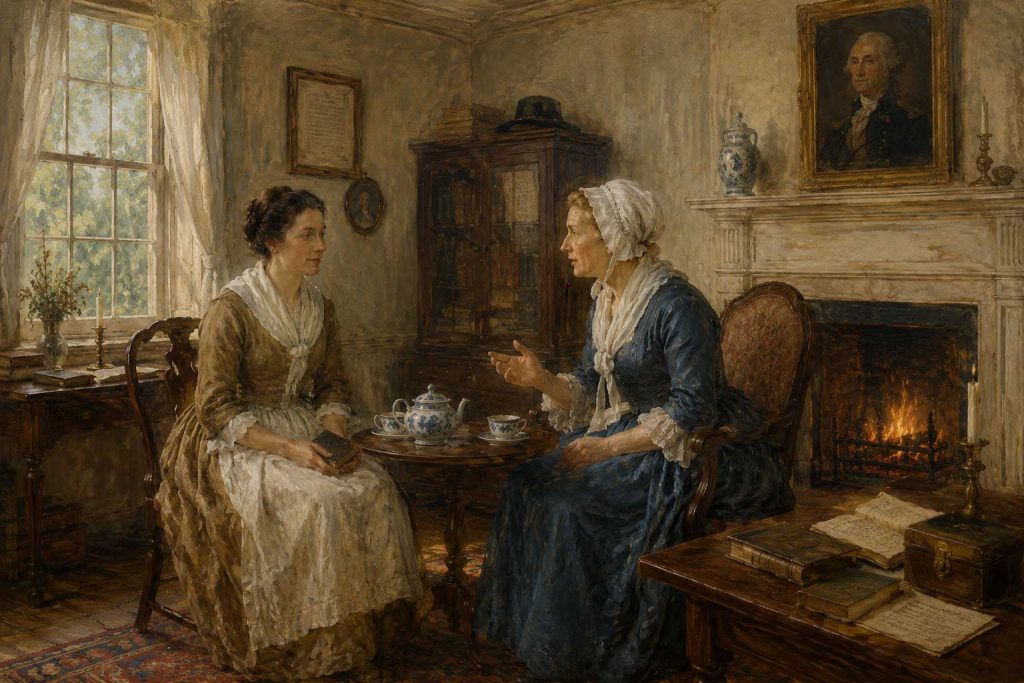
Henrietta Bentley was the daughter of a prominent Sandy Spring Quaker family. She was widely read, deeply devout, and – by the standards of the day – unusually well-connected outside the Friends community. Her closest friend from girlhood had been a young woman named Dolley Payne, who had grown up Quaker in North Carolina and Philadelphia. The two had stayed close as Dolley moved to Washington, married a Virginian named James Madison, and became First Lady.
It was Henrietta Bentley’s house Madison rode toward on the evening of August 26. It is not certain how much was coincidence and how much was the quiet logic of friendship.
Dolley Madison was born Dolley Payne in 1768, in a Quaker settlement in North Carolina, to a Quaker family who later moved north to Philadelphia. She was raised in the Friends tradition – plain dress, plain speech, the silence and discernment of meeting. When she married James Madison in 1794, she was formally disowned by the Society of Friends for marrying outside the faith.
She kept the friendships, though. Henrietta Bentley was one of them.
Two days before her husband arrived in Brookeville, Dolley had been at the White House, refusing to leave until the famous Gilbert Stuart portrait of George Washington had been cut from its frame and carried to safety. She fled the city only as the British were entering it. She did not make it to Brookeville. She sheltered separately, twenty miles to the southwest, and reunited with her husband days later.
But the friendship was the reason the Bentley house was a place Madison knew to go. In a country with no capital, a President needed somewhere to go that felt like family. Brookeville was that place because Dolley had a friend there.
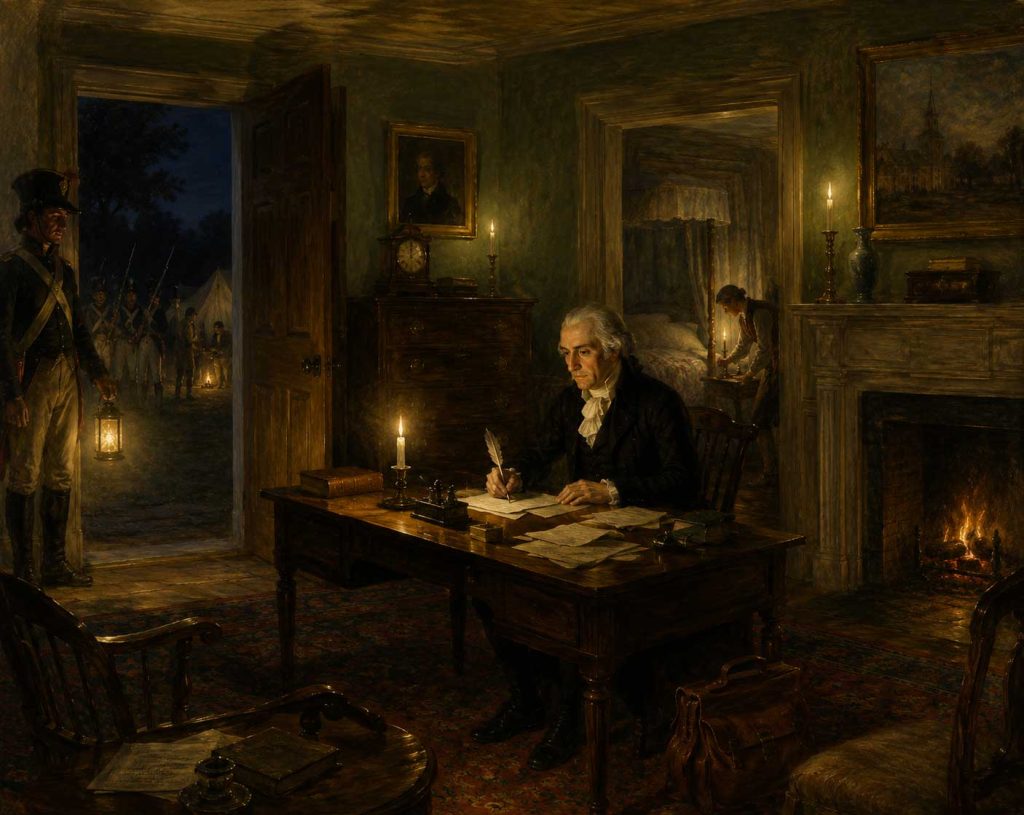
The Bentleys made the parlor into a bedroom for the President. The officers who had ridden with him – General Mason, Attorney General Richard Rush, the dragoon guards – were given Mrs. Bentley’s private rooms and the upstairs. The yard filled with soldiers. Lanterns burned through the night.
Madison did not sleep. By every account, he sat up at the desk in the parlor and worked. Dispatches went out to General William Winder, who was trying to reorganize what was left of the American army. A letter went to James Monroe. Another to his wife, telling her where he was.
Margaret Bayard Smith, listening from upstairs, wrote that the house was “like a camp,” with soldiers moving in and out, horses in the yard, and the candles in the parlor burning all the way until dawn.
For one night, the United States government was the work being done at a desk in a Quaker silversmith’s house. The President was the man at the desk. The Cabinet was the men sleeping in the rooms above him. The Treasury was whatever was in the saddlebags by the door.
Outside, the village was quiet.
In the morning, word arrived: the British had left Washington. They had burned what they intended to burn, and they were marching east, toward Baltimore.
Madison wrote a final letter at the parlor desk – a short note to Dolley telling her it was safe to come home. Then he and his party mounted and rode south, back toward the city he had left three days before.
He returned to a capital in ashes. The White House was a shell. The Capitol was gutted. The Treasury Building had collapsed in on itself. But the government still existed. Madison had carried it with him in his saddlebags through Virginia and Maryland, and he had quietly set it down for a night in a parlor in Brookeville before bringing it home.
The Bentleys went back to their lives. Caleb returned to the post office and the silver shop. Henrietta resumed her correspondence with Dolley. The village remembered the night, but it did not advertise it. That was the Quaker way.
It is the town’s motto today: “United States Capital For A Day, August 26, 1814.”
The house is still there. The Bentley house – the Madison House, as it is sometimes called – stands on Market Street, two blocks from where Madison Manor is being built. It is privately owned, lovingly preserved. The original woodwork is still in place. The windows Madison wrote dispatches by are still in their frames.
The green where the cabinet gathered is unchanged. The Academy still teaches. The streets run the same lines they ran in 1814.
Brookeville did not become famous after that night. It did not industrialize, did not sprawl, did not chase what the rest of Montgomery County chased. It stayed small. It stayed Quaker, in spirit if not entirely in fact. It kept the buildings and the rhythm and the trees.
For two hundred and ten years, it has been the same town.
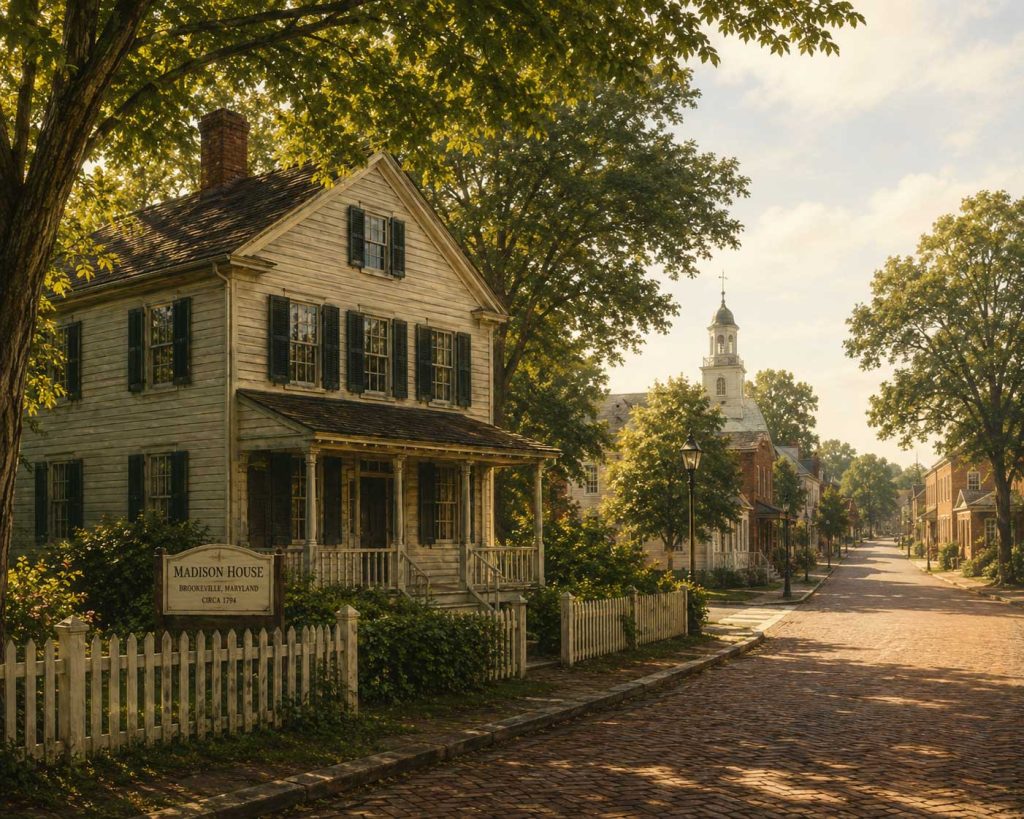
Madison Manor is the only new residential community ever built on High Street, inside the Brookeville National Register Historic District. Four estates – The Bentley Manor, The Treasury House, The Dolley Suite, and The Madison Grand – each named for the people and the moment of August 1814.
The names are not decoration. They are the reason these homes belong here. The land they sit on is the land Madison rode toward in the gathering dusk. The streets are the same streets. The neighbors, in a deep sense, are the same neighbors.
This is not a development. It is a continuation of a story that has been quietly waiting for the next chapter.